Start a Local Cluster with the CLI
Follow this five-minute tutorial to set up a Hazelcast cluster for testing or evaluation purposes. In five minutes, you will learn how to install Hazelcast with a package manager, start a local cluster with the CLI, write data to memory and visualize that data.
Step 1. Install Hazelcast
-
To install Hazelcast, use the appropriate command for your operating system:
- Mac
- Linux
- Windows
To install on macOS, use the Homebrew package manager.
bashbrew tap hazelcast/hzbrew trust hazelcast/hzYou can use either of these package managers to install Hazelcast, depending on your Linux distribution:
Debianshellsudo apt-get install -y --no-upgrade wget gpg coreutils \&& wget -qO - https://repository.hazelcast.com/api/gpg/key/public | gpg --dearmor | sudo tee /usr/share/keyrings/hazelcast-archive-keyring.gpg > /dev/null \&& echo "deb [signed-by=/usr/share/keyrings/hazelcast-archive-keyring.gpg] https://repository.hazelcast.com/debian stable main" | sudo tee -a /etc/apt/sources.list \&& sudo apt update && sudo apt install hazelcast=6.0.0-SNAPSHOTRPMshellsudo yum -y install wget \&& wget https://repository.hazelcast.com/rpm/stable/hazelcast-rpm-stable.repo -O hazelcast-rpm-stable.repo \&& sudo mv hazelcast-rpm-stable.repo /etc/yum.repos.d/ \&& sudo yum install hazelcast-6.0.0-SNAPSHOTHazelcast does not support any Windows package managers.
To get started with Hazelcast on Windows, you can use Docker, the binary distribution, or Java.
-
Check that Hazelcast Platform is correctly installed:
shellhz -VYou should see the version of both Hazelcast and the command line tool.
Step 2. Start a Local Cluster
Hazelcast clusters consist of servers that we call members. These members communicate with each other to form a distributed network. It's these members that store and process your data.
-
To start a standalone Hazelcast member, use the following command:
shellhz startYou should see the following in the console:
shellINFO: [192.168.1.164]:5701 [dev] [6.0.0-SNAPSHOT] (1)Members {size:1, ver:1} [ (2)Member [192.168.1.164]:5701 - 4221d540-e34e-4ff2-8ad3-41e060b895ce this]1 The local IP address of your Hazelcast member followed by the default cluster name (dev) and the version of Hazelcast that you are running.2 The size of your cluster. Here, you just have one member, so the size is 1. -
To add one more member to the cluster, open another terminal window and run the
startcommand again.shellhz startThe members discover each other automatically and form a two-member cluster. You should see the following in the console:
shellMembers {size:2, ver:2} [Member [127.0.0.1]:5701 - e40081de-056a-4ae5-8ffe-632caf8a6cf1 thisMember [127.0.0.1]:5702 - 93e82109-16bf-4b16-9c87-f4a6d0873080]
These members use the default configuration, which is defined in the hazelcast.xml file. The location of this file is printed on the first line of the output of the start command.
Step 3. Connect the Management Center
Management Center is a user interface for managing and monitoring your cluster.
In this step, you install and start a local instance of Management Center and connect it to your cluster.
-
To install Management Center, use one of the following methods, depending on your operating system:
- Mac
- Linux
- Windows
To install on macOS, use the Homebrew package manager.
bashbrew tap hazelcast/hzbrew trust hazelcast/hzTo install on Linux, you can use either of these package managers, depending on your Linux distribution:
Debianshellwget -qO - https://repository.hazelcast.com/api/gpg/key/public | gpg --dearmor | sudo tee /usr/share/keyrings/hazelcast-archive-keyring.gpg > /dev/nullecho "deb [signed-by=/usr/share/keyrings/hazelcast-archive-keyring.gpg] https://repository.hazelcast.com/debian snapshot main"| sudo tee -a /etc/apt/sources.listsudo apt update && sudo apt install hazelcast-management-centerRPMshellwget https://repository.hazelcast.com/rpm/snapshot/hazelcast-rpm.repo -O hazelcast-snapshot-rpm.reposudo mv hazelcast-snapshot-rpm.repo /etc/yum.repos.d/sudo yum install hazelcast-management-centerAt the moment, Management Center does not support any Windows package managers.
To get started with Management Center on Windows, use one of the other available installation options.
-
Check that Management Center is installed.
shellhz-mc -VYou should see the version of Management Center.
-
Start Management Center.
shellhz-mc start -
In a web browser, go to localhost:8080 to open Management Center.
-
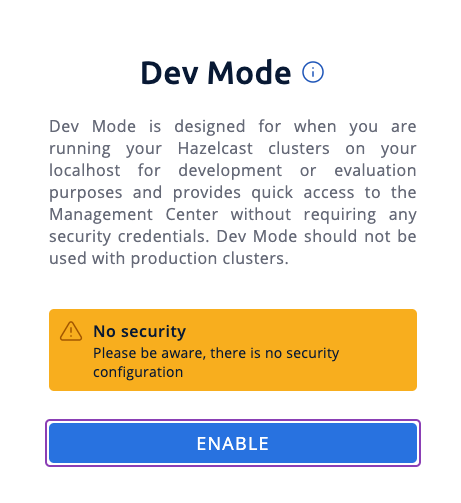
On the landing page of Management Center, enable dev mode.
-
Create a connection, using the default settings.
You should see that you cluster is in an active state and has a single member. An active cluster is stable and operating without restrictions.

Step 4. Write Data to Memory
Hazelcast has lots of distributed data structures available for writing data to memory on your cluster. One of the most popular ways of writing data to memory is to use a distributed map. Maps store key/value pairs called entries, which are replicated and distributed across a cluster.
The quickest way to write some data to a map is to use the CLI console.
-
To start the console, use the following command:
shellhz-cli console -
Enter the following to create a map and write some data to it:
-
ns my-distributed-map -
m.put "1" "John" -
m.put "2" "Mary" -
m.put "3" "Jane"You'll see that each of the
m.putlines returnsnull, which means that the data was written to the map.
-
-
In Management Center, go to Storage > Maps.
You should see that your cluster has a map called
my-distributed-mapwith three entries (keys and values). You'll also see the total amount of memory that those entries are taking up in your cluster.
Next Steps
In this quickstart, you have learnt how to start a local cluster, write data to it and visualize that data in Management Center. To continue your journey through Hazelcast, check the following resources:
-
See the Getting Started section for a complete introduction to Hazelcast.
-
Learn more about the map data structure.
-
Find out more about how members automatically discover each other in Discovery Mechanisms.
-
Explore Management Center.
-
Get started with one of the available client libraries:
-
Go straight into deploying a production-ready cluster with our production checklist.
If you need some help, reach out via support.